
Tools & Takeaways
Top Questions Posed by Property Consumers to CEA in 2026
10 April 2026
What are the top questions that property consumers frequently ask CEA? This CEAnergy article has the answers!
April 2026 - 3 min read
There are some questions that property consumers like yourself frequently ask CEA, usually involving what property agents are required to do when facilitating property transactions.
In this CEAnergy article, we list five of the most popular questions in 2026 along with the answers to these burning questions!
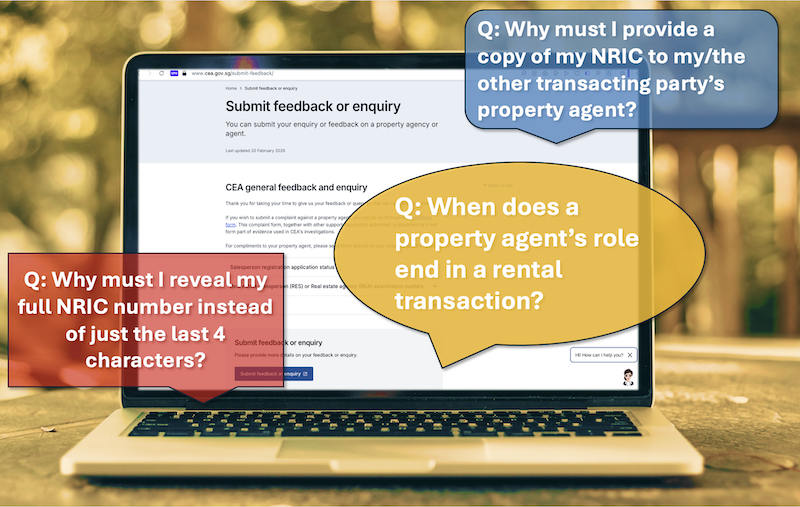
Q: Why must I show/ provide a copy of my NRIC to my/ the other transacting party’s property agent?
Under the Estate Agents (Prevention of Money Laundering, Proliferation Financing and Terrorism Financing) Regulations 2021 (PMLPFTF Regulations), all property agencies and property agents are legally required to conduct due diligence checks on both their clients and counterparties in a property transaction who are not represented by a property agent, before any agreement to buy, sell, or lease a property is entered into.
Property agencies and property agents can therefore request to check your original NRIC and make copies for the purposes of facilitating your property transaction, whether it is for a sales or lease transaction.
The types of information that property agents are required to collect, verify, and record include details such as your:
Full name and NRIC number
Date of birth
Occupation
Additionally, as required by the Practice Guidelines on Due Diligence Checks under the Women’s Charter 1961 and Immigration Act 1959, property agents are required to check and make copies of the original NRIC and/ or immigration/ work/ student passes and/ or passports of all tenants and occupiers for residential rental transactions that they facilitate.
Important note: If you refuse to provide the required information such as your full NRIC number and/ or identification documents, the property agent will be unable to fulfil their legal obligation to conduct due diligence and cannot proceed with the property transaction.
You are advised to verify the identity of the property agent to ensure that the person you are dealing with is a CEA-registered property agent. You should use the phone number advertised or used by the person to perform a search on the CEA Public Register. If the search does not lead to a property agent’s profile page, it means that the phone number is not registered with CEA.
Q: Why must I reveal my full NRIC number instead of just the last 4 characters? Can I just use the Singpass app to show my NRIC?
As stated by the Ministry of Digital Development and Information (MDDI), the use of partial NRIC numbers is not reliable for identifying individuals accurately. This is because some individuals may share the same partial NRIC numbers, and there are instances where two individuals share both the same name and partial NRIC number.
The use of full NRIC numbers is needed to identify individuals accurately.
You can use the Digital NRIC card (with full details shown) within the Singpass app in lieu of your physical NRIC card.
Q: When does a property agent’s role end in a rental transaction?
CEA regulates the practice of property agencies and property agents in property transactions, specifically the conduct of estate agency work as defined in the Estate Agents Act 2010 in Singapore, in respect of properties situated in and outside Singapore.
Under CEA’s regulatory framework, a property agent’s role ends after the landlord and tenant have signed the tenancy agreement and the property is handed over to the tenant.
While the property agent may offer to assist the landlord or tenant with property management matters, such as facilitating repairs to faulty appliances or furniture during the tenancy period, these are not considered part of estate agency work and fall outside of CEA’s regulatory purview.
In short, property management services are not covered under CEA’s regulatory framework and are regarded as a private arrangement or service. As such, CEA is not empowered to handle disputes arising from such property management matters.
You can check with your property agent whether he or she provides this service and if additional fees will apply.
Find out what you should take note of when you engage a property agent for your transaction.
Q: What can be done if after the tenancy agreement has ended, (a) I have not received my deposit from the landlord, OR (b) I disagree with the deductions made to my rental deposit by the landlord?
CEA will not be able to act on disputes that do not involve estate agency work. This includes private contractual disputes between landlords and tenants.
Accordingly, CEA ‘s purview does not extend to issues arising from the management of properties such as disputes concerning the repair or replacement of items in the rental unit or private contract disputes with the landlord such as the refund of security deposits.
Q: Can I refuse to pay the renewal commission after my current tenancy expires, as I feel that my agent did not do anything for me and I renewed directly with the landlord/ tenant?
This is a private contractual matter between a landlord/ tenant and property agent, which you might wish to seek independent legal advice on.
Property consumers are advised to read any agreement or contract carefully before signing and are encouraged to approach the property agent’s property agency to resolve the dispute.
In the event that you cannot resolve the dispute with the property agency or property agent, you may use CEA's Dispute Resolution Scheme if you have signed CEA’s prescribed estate agency agreement with the property agency, and the dispute is one which has arisen based on the terms of the estate agency agreement.
(Source photo by Ben Kolde on Unsplash)
Information accurate as at 10 April 2026