
Industry Spotlight
Commonly Asked Questions on the New Currency Requirement
26 August 2026
Three commonly asked questions on the new Currency Requirement, answered.
Aug 2026 – 3 min read
The new Currency Requirement that takes effect from 1 January 2027 was among the major changes announced by Ms Sun Xueling, Senior Minister of State for National Development and Transport (opens in new tab), at the Singapore Estate Agents Conference 2026 held on 28 July 2026.
Since the announcement, CEA has received queries from real estate salespersons (RESs) seeking clarification on the new requirement.
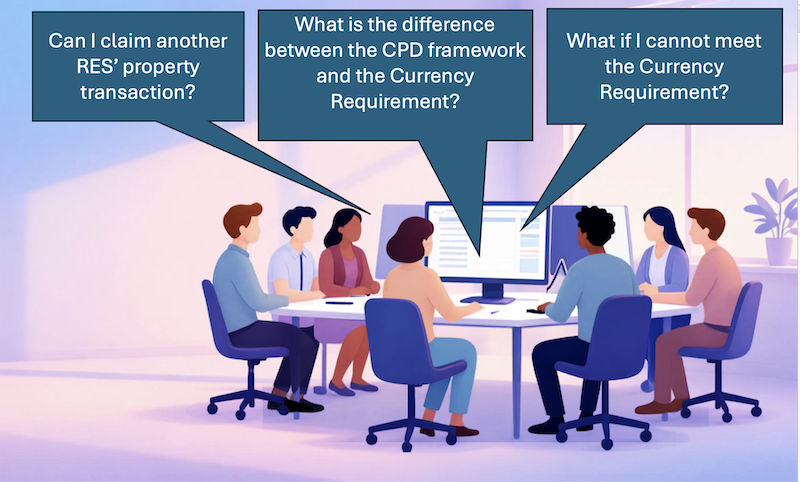
In this CEAnergy article, we share three commonly asked questions, including whether RESs can claim another RES’ property transaction to fulfil the Currency Requirement.
Q: What is the difference between the Continuing Professional Development (CPD) framework and the Currency Requirement?
The Continuing Professional Development (CPD) framework and the Currency Requirement work together to raise professional standards in the real estate agency industry. The CPD framework and Currency Requirement serve distinct but complementary purposes.
The CPD framework (opens in new tab) ensures that RESs have the skills and competencies to carry out their duties effectively. Under the enhanced CPD requirements that took effect from 1 January 2026, RESs and Key Executive Officers (KEOs) are required to complete 16 training hours each year to maintain their registrations.
The Currency Requirement, on the other hand, ensures that RESs maintain currency of knowledge of the relevant rules and regulations, property transaction processes, and market trends, so that they can provide up-to-date advice to their clients. Under the Currency Requirement, RESs must complete at least three property transactions within every three-year cycle, or pass a Refresher Examination, to be eligible for registration renewal for the next three years.
Note: As part of a Whole-of-Government effort to foster a pro-enterprise environment, CEA will be extending the validity periods for EA licence and RES registration from one year to three years (opens in new tab).
The first three-year cycle will run from 1 January 2027 to 31 December 2029.
Q: What are my options to meet the Currency Requirement if I cannot close a minimum of three property transactions within three years?
Passing the Refresher Examination is an alternative pathway to meet the Currency Requirement.
If you have not managed to complete at least three transactions by the end of the three-year cycle, you will be eligible to sit for the Refresher Examination.
As the Currency Requirement is mandatory for registration renewal, CEA will ensure that all eligible candidates are guaranteed a seat for the Refresher Examination. More information about the Refresher Examination will be announced by the first half of 2029.
CEA may also grant waivers on a case-by-case basis in extenuating circumstances, such as in cases of serious medical conditions or where an RES is involved in complex transactions.
Note: If you are a new RES, you will not be required to complete any transaction in your first year of registration.
However, you must complete at least two property transactions during the remaining two years of your three-year registration cycle, or pass the Refresher Examination, to be eligible for registration renewal.
Q: Can I claim another RES’ property transaction to fulfil the Currency Requirement?
No, the property transaction can only be accorded to the RES who conducted the estate agency work to close the transaction.
Submitting a property transaction that was in fact handled by another RES would constitute the submission of false or misleading information. CEA will not hesitate to take firm action against any RES who does so.
Note: Under the Estate Agents Act (opens in new tab) 2010, estate agencies (EAs) and RESs are required to submit property transaction records to CEA.
It is an offence to submit false or misleading information.
CEA takes a serious view of such misconduct. Offenders may be prosecuted in Court. The offence is punishable with a fine of up to $10,000, imprisonment of up to 12 months, or both.
In the case of a continuing offence, a further fine not exceeding $1,000 could be imposed for every day or part of a day during which the offence continues after conviction.
For the majority of property transactions, CEA will recognise one RES for each side of a completed property transaction (i.e. one RES representing the buyer/ tenant and one RES representing the seller/ landlord).
If RESs worked in a team to represent the same transacting party for a transaction, the estate agent (EA) will determine which RES should be accorded the transaction based on the work done. This is consistent with the current approach when EAs submit their RESs’ property transaction records to CEA for publication in the Public Register.
For more complex transactions, such as the sale of high-end commercial and industrial properties or en bloc transactions, CEA may recognise up to five RESs per side of the transaction. In such instances, CEA will assess the supporting documents submitted by the EA to determine the number of RESs and which RESs to be recognised, on a case-by-case basis.
Information accurate as at 26 Aug 2026